


Page 110 - Consulate-Romania
P. 110
Create space for innovation

        Companies that want to innovate disruptively must give their employees the freedom

        to propose and test innovations. This means actively encouraging experimentation,
        but also providing your employees with the necessary tools to invest part of their

        work hours in innovation projects. So dare—cautiously—to tweak the hierarchy,
        collaboration models, and existing communication channels, because radical

        innovation doesn’t stand a chance in a closed “corporate” environment.

        Everyone Can Be Disruptive


        Disruptive technology extends beyond the dynamic world of startups. SMEs and large
        companies can also engage in disruptive entrepreneurship. This does, however,

        require a shift in mindset among all your employees. How to bring this about is a
        story in itself, but start by having a clear conversation about it with your employees.

        Once everyone is on board with the vision, ideas can begin to bubble up.

        Every industry is different

        You know your industry best. Look for strategies tailored to your sector to innovate

        digitally and stay one step ahead of the competition. Don’t just copy the market
        leader; instead, think creatively about what can be improved—and which technology

        can get the job done. Digital disruption offers no guarantee of success, but even a
        failed experiment can be extremely instructive.


        Every entrepreneur has realized that we are in a period of transformational change
                                       that requires us—and every entrepreneur—to anticipate it.

                                       At this stage, everything is in flux, and the traditional
                                       business organization will disappear; however, there are also

                                       initiatives to better focus on the future, and these initiatives
                                       have been provisionally named DRN 2.0.

                                       In an era of relentless disruption, accelerated by AI, business
                                       leaders face an enormous challenge: how do they remain

                                       competitive while simultaneously preserving their purpose,
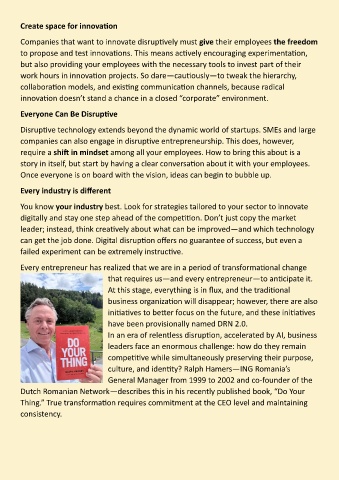
                                       culture, and identity? Ralph Hamers—ING Romania’s
                                       General Manager from 1999 to 2002 and co-founder of the

        Dutch Romanian Network—describes this in his recently published book, “Do Your

        Thing.” True transformation requires commitment at the CEO level and maintaining
        consistency.

