


Page 118 - Consulate-Romania
P. 118
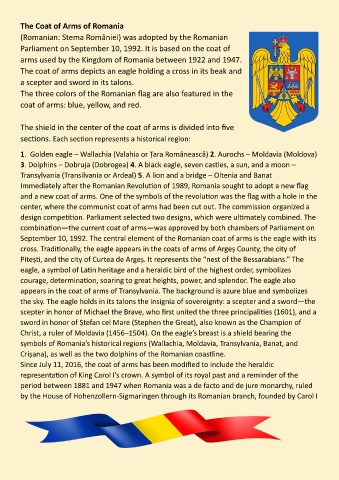
The Coat of Arms of Romania
        (Romanian: Stema României) was adopted by the Romanian

        Parliament on September 10, 1992. It is based on the coat of
        arms used by the Kingdom of Romania between 1922 and 1947.

        The coat of arms depicts an eagle holding a cross in its beak and
        a scepter and sword in its talons.

        The three colors of the Romanian flag are also featured in the
        coat of arms: blue, yellow, and red.


        The shield in the center of the coat of arms is divided into five

        sections. Each section represents a historical region:

        1.  Golden eagle – Wallachia (Valahia or Țara Românească) 2. Aurochs – Moldavia (Moldova)
        3. Dolphins – Dobruja (Dobrogea) 4. A black eagle, seven castles, a sun, and a moon –

        Transylvania (Transilvania or Ardeal) 5. A lion and a bridge – Oltenia and Banat
        Immediately after the Romanian Revolution of 1989, Romania sought to adopt a new flag
        and a new coat of arms. One of the symbols of the revolution was the flag with a hole in the
        center, where the communist coat of arms had been cut out. The commission organized a

        design competition. Parliament selected two designs, which were ultimately combined. The
        combination—the current coat of arms—was approved by both chambers of Parliament on

        September 10, 1992. The central element of the Romanian coat of arms is the eagle with its
        cross. Traditionally, the eagle appears in the coats of arms of Argeș County, the city of
        Pitești, and the city of Curtea de Argeș. It represents the “nest of the Bessarabians.” The
        eagle, a symbol of Latin heritage and a heraldic bird of the highest order, symbolizes

        courage, determination, soaring to great heights, power, and splendor. The eagle also
        appears in the coat of arms of Transylvania. The background is azure blue and symbolizes
        the sky. The eagle holds in its talons the insignia of sovereignty: a scepter and a sword—the

        scepter in honor of Michael the Brave, who first united the three principalities (1601), and a
        sword in honor of Ștefan cel Mare (Stephen the Great), also known as the Champion of
        Christ, a ruler of Moldavia (1456–1504). On the eagle’s breast is a shield bearing the
        symbols of Romania’s historical regions (Wallachia, Moldavia, Transylvania, Banat, and

        Crișana), as well as the two dolphins of the Romanian coastline.
        Since July 11, 2016, the coat of arms has been modified to include the heraldic

        representation of King Carol I’s crown. A symbol of its royal past and a reminder of the
        period between 1881 and 1947 when Romania was a de facto and de jure monarchy, ruled
        by the House of Hohenzollern-Sigmaringen through its Romanian branch, founded by Carol I

