


Page 122 - Consulate-Romania
P. 122
Romanian Villages

        Dutch Traces in Transylvania

        An ethnographic and linguistic study conducted by Operation Villages Roumains (OVR-

        NL) has established that, in addition to the often-mentioned Saxons from the Rhine
        and Moselle regions and Lorraine (as well as people from Luxembourg and the
        Southern Netherlands (Zeeland, North Brabant, Limburg, and Flanders) settled in

        Sibiu and Alba Iulia and the surrounding area at the invitation of the Hungarian King
        Géza (1141–1162), as evidenced by, among other places, Bărăbanț, a Romanian

        village in the municipality of Alba Iulia.
        In short, you can trace your ancestors there.


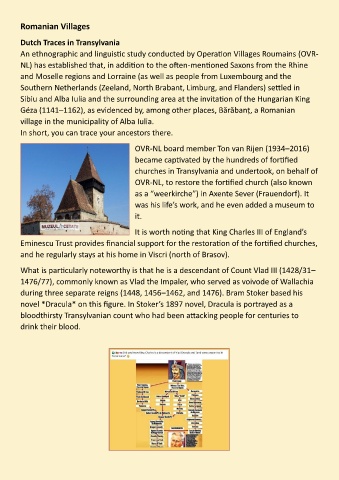
                                                OVR-NL board member Ton van Rijen (1934–2016)
                                                became captivated by the hundreds of fortified

                                                churches in Transylvania and undertook, on behalf of
                                                OVR-NL, to restore the fortified church (also known

                                                as a “weerkirche”) in Axente Sever (Frauendorf). It
                                                was his life’s work, and he even added a museum to

                                                it.

                                                It is worth noting that King Charles III of England’s
        Eminescu Trust provides financial support for the restoration of the fortified churches,

        and he regularly stays at his home in Viscri (north of Brasov).

        What is particularly noteworthy is that he is a descendant of Count Vlad III (1428/31–

        1476/77), commonly known as Vlad the Impaler, who served as voivode of Wallachia
        during three separate reigns (1448, 1456–1462, and 1476). Bram Stoker based his

        novel *Dracula* on this figure. In Stoker’s 1897 novel, Dracula is portrayed as a
        bloodthirsty Transylvanian count who had been attacking people for centuries to

        drink their blood.

